medival institutions in spain
Political organization and institutions:
The kingdom of Castile
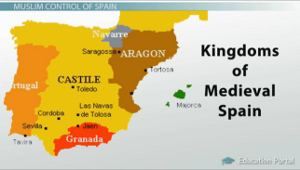
In the western part of the peninsula appeared three major political centers: the kingdoms of Portugal, León and Castile. Portugal followed a distinct history and León and Castile lived a complex process in which both crowns were united and disunited along the eleventh and twelfth centuries. Finally Ferdinand III of Castile took place the definitive union in 1230.
The territorial organization of the kingdom was very complex. Within the kingdom of Castile was the kingdom of Galicia, the lordship of Biscay and Álava and Guipúzcoa. So the king had the titles of King of Castile, Leon, lord of Biscay ...
The political history of the fourteenth and fifteenth centuries was really complex and was full of crisis. The strengthening of royal power by Alfonso XI got the approval of the Ordinance of Alcala in 1348, was followed by a brutal civil war crisis between Pedro I the Cruel and Henry II of Castile. The victory of the latter brought a new dynasty, the Trastámara, power and strengthening ("enriqueñas grants") nobiliar power.
Castilla failed to annexation of Portugal in the battle of Aljubarrota (1385).
In the fifteenth century, the reigns of John II and Henry IV saw major internal conflicts in which the nobility reinforced their positions. A Henry IV was succeeded by his sister Isabella of Castile, the future Isabella.
Institutions
The king looked assisted in his action by various central government institutions: the Royal Council, the Court, in charge of the administration of justice, and the Royal Treasury, responsible for taxes.
In these centuries were built two key institutions for the real power: a permanent Royal Army and increasingly complex bureaucracy, consisting of lawyers, experts trained in universities.
In the twelfth century (1188) were born Courts, estates assembly composed of representatives of the nobility, clergy and towns. The agency had no legislative power but decided on extraordinary taxes and had the ability to petition the king.
The local administration was based on the institution of councils. Councils Councils or terminated under the control of urban oligarchies (nobility, clergy, bourgeoisie).
The Crown of Aragon
The kingdom of Aragon rather than a unified kingdom was a confederation of kingdoms, Aragon, Valencia and Mallorca, and the Principality of Catalonia had different institutions and laws.
Often the Aragonese monarchy as a "pactista monarchy", in which the monarch's power was weak and the king had to agree with the privileged classes and respect the laws of each kingdom when a decision is characterized.
In front of each kingdom was a lieutenant of the King who acted as his deputy.
Other institutions were the Royal Council and the Court.
In the thirteenth century were born Courts in the kingdoms of Catalonia, Aragon and Valencia. They were bodies in each kingdom and were gaining increasing power.
Courts were estates assemblies where representatives of the two privileged classes and the urban patriciate (Gentry cities) are met. Dominated by the nobility and clergy, controlled the power of the monarch and mourned by feudal interests of the clergy and nobility limiting the power of the monarch.
The Catalan Cortes created an institution, the General Council or Generalitat of Catalonia, which became in fact a kind of government of the Principality. In Valencia and Aragon were subsequently created Councils of the Kingdom, similar to the Catalan institutions.
Existed the institution of Justice of Aragon, cargo assigned to a member of the nobility who watched over maintaining class privileges against the power of the king in Aragon.
The territorial administration was organized in merindades or veguerías. The organ of power in cities was the town in the late Middle Ages came under the control of local oligarchies (Concell de Cent of Barcelona)

No hay comentarios:
Publicar un comentario