lunes, 18 de mayo de 2015
Others Explorers
Vasco Nuñez de Balboa
Vasco Nunez de Balboa (Jerez de los Caballeros, now the province of Badajoz, c 1475 -. Acla, Panama Current, January 15, 1519) was a pioneer, explorer and Spanish conqueror ruling. It was the first European to see the Pacific Ocean from its eastern coast and the first European city to establish a permanent American mainland
Vasco Nunez de Balboa was born around 1475 in the frontier town of Jerez de los Caballeros, which was then called Jerez near Badajoz and belonged to the Order of Santiago.1
The name comes from the castle Balboa Balboa, near Villafranca del Bierzo, in the present province of Leon (Spain). It is believed that his father was the gentleman Alvaro Nunez (or Martinez) Balboa, 2 but who his mother was not known almost nothing. He had at least three brothers Gonzalo, of notary profession, Juan and Alvaro. It is uncertain bit of his childhood, except that he learned to read and write, unlike other Spanish conquerors, 3 and esgrima.4
During his teenage years he served as a page and squire of Pedro Portocarrero, VIII Mr. of Moguer. He lived in Cordoba and had Sevilla.5 house in Moguer Perhaps it was witnessing the preparations and development of Columbus' first voyage to the Indies
Amerigo Vespucio
Amerigo Vespucci (Italian Amerigo Vespucci 1 / ameriɡo vesputtʃi /) (9 March 1454.2 Florence - February 22, 1512, Sevilla) was a Florentine merchant and cosmógrafo, naturalized Castilian in 1505, who participated in at least two trips exploration to the New World continent that today is called America in his honor. He held important positions in the House of Trade in Seville, which was named "Chief Pilot" in 1508; but its universal fame is due to two works published under his name between 1503 and 1505: the Mundus Novus and the letter to Soderini, who attributed a leading role in the discovery of America and its identification as a new continent. For this reason the cartographer Martin Waldseemüller in his map of 1507 coined the name "America" in his honor as a designation for the New World. The story often fanciful and contradictory of his travels have located one of the most controversial figures of the Age of Discovery.
Ferdinan Magellan
Ferdinand Magellan (in ancient and modern Portuguese: Fernando de Magalhães or Fernão de Magalhães; Sabrosa, Northern Region, Portugal, spring 1480-Mactan, Philippines, April 27, 1521), also known as Ferdinand Magellan, was a military, marine and Portuguese navigator of noble lineage, named by Hispanic Monarchy advance, commander in chief of the "Armed to the discovery of spices" and knight of the Order of Santiago.
The service of Charles I, discovered the natural channel navigable today called Strait of Magellan, the first European to go sailing from the Atlantic Ocean to the Pacific Ocean, previously called South Sea. He began the expedition, led to his death by Juan Sebastian Elcano, to achieve the first circumnavigation of the Earth in 1522
Juan Sebastian el Cano
Juan Sebastian Elcano, also written Juan Sebastian de Elcano, Juan Sebastian del Cano and Juan Sebastian de Elcano (Guetaria, 1476-Pacific Ocean, August 4, 1526) was a Spanish sailor who participated in the first round the world, being the head of the expedition after the death of Fernando de Magallanes.Era son of Catherine the port and Juan Domingo Elcano. From a young age, he enlisted in fishing and commercial boats, so it took great seafaring experience. In 1509 he took part in the expedition against Algiers, which was directed by Cardinal Francisco Jiménez de Cisneros. The return of the same, settled in Seville, and it was there that I learned of the project being prepared by the Portuguese sailor Ferdinand Magellan, to discover a route to India by the West, through a passage or strait through Southern America, to carry the Spice Islands without skirting the African continent or cross domains portugueses.1
That was how in 1519 Elcano enlisted in Magellan's expedition as foreman of the Conception, one of five making up the fleet ship.

miércoles, 8 de abril de 2015
printing press
History
Diamond Sutra, found in the cave of Dunhuang (China). It is the printed document dated oldest known preserved. Was held on May 11 of the year 871.1
The Romans had stamps printed sheets inscriptions on clay objects around the year 440 a. C. and 430. C. Between 1041 and 1048, Bi Sheng invented in China, where there was already a rice-paper type the first system of movable type, based on complex pieces of porcelain in which Chinese characters were carved; this was a complex procedure by the vast number of characters that were needed to Chinese writing. In 1234 craftsmen of the kingdom of Koryo (now Korea), connoisseurs of Chinese progress with movable type, created a set of movable metal type that anticipated modern printing, but used it raramente.2 However, modern printing was not created until approximately 1440, with the help of Johannes Gutenberg.
In Europe, many individuals and populations pretended to be part of this art; although opinions suggest that was the alemánJohannes Gutenberg, the ideas I had and the initiative to join a team of printers, supporting him as the inventor of latipografía. There subsequent documentation credited with inventing though, curiously, is not named in any known Gutenberg printed.
Given the controversial history appeared to dispute the glory of the "Father of Printing" German names Mentelin, printer Strasbourg (1410-1478); Italian Panfilo Castaldi, doctor and then typographer in 1470, another Italian named Aldus, Lorenzo de Coster of Haarlem (Netherlands) (1370-1430). Each has a monument in their respective localities; however, lost the lawsuit definitely Mentelin supporters and Castaldi.
An edition dating from 1502 in Mainz, Germany, printed by Peter Schöffer, successor to the press that in the past belonged to Gutenberg says:
... This book was printed in Mainz, the city where the admirable art of typography was invented in 1450 by Johannes Gutenberg witty and then perfected at the expense and work of Johann Fust and Peter Schöffer ... among others .. .
jueves, 19 de febrero de 2015
medival institutions in spain
Political organization and institutions:
The kingdom of Castile
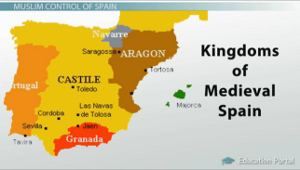
In the western part of the peninsula appeared three major political centers: the kingdoms of Portugal, León and Castile. Portugal followed a distinct history and León and Castile lived a complex process in which both crowns were united and disunited along the eleventh and twelfth centuries. Finally Ferdinand III of Castile took place the definitive union in 1230.
The territorial organization of the kingdom was very complex. Within the kingdom of Castile was the kingdom of Galicia, the lordship of Biscay and Álava and Guipúzcoa. So the king had the titles of King of Castile, Leon, lord of Biscay ...
The political history of the fourteenth and fifteenth centuries was really complex and was full of crisis. The strengthening of royal power by Alfonso XI got the approval of the Ordinance of Alcala in 1348, was followed by a brutal civil war crisis between Pedro I the Cruel and Henry II of Castile. The victory of the latter brought a new dynasty, the Trastámara, power and strengthening ("enriqueñas grants") nobiliar power.
Castilla failed to annexation of Portugal in the battle of Aljubarrota (1385).
In the fifteenth century, the reigns of John II and Henry IV saw major internal conflicts in which the nobility reinforced their positions. A Henry IV was succeeded by his sister Isabella of Castile, the future Isabella.
Institutions
The king looked assisted in his action by various central government institutions: the Royal Council, the Court, in charge of the administration of justice, and the Royal Treasury, responsible for taxes.
In these centuries were built two key institutions for the real power: a permanent Royal Army and increasingly complex bureaucracy, consisting of lawyers, experts trained in universities.
In the twelfth century (1188) were born Courts, estates assembly composed of representatives of the nobility, clergy and towns. The agency had no legislative power but decided on extraordinary taxes and had the ability to petition the king.
The local administration was based on the institution of councils. Councils Councils or terminated under the control of urban oligarchies (nobility, clergy, bourgeoisie).
The Crown of Aragon
The kingdom of Aragon rather than a unified kingdom was a confederation of kingdoms, Aragon, Valencia and Mallorca, and the Principality of Catalonia had different institutions and laws.
Often the Aragonese monarchy as a "pactista monarchy", in which the monarch's power was weak and the king had to agree with the privileged classes and respect the laws of each kingdom when a decision is characterized.
In front of each kingdom was a lieutenant of the King who acted as his deputy.
Other institutions were the Royal Council and the Court.
In the thirteenth century were born Courts in the kingdoms of Catalonia, Aragon and Valencia. They were bodies in each kingdom and were gaining increasing power.
Courts were estates assemblies where representatives of the two privileged classes and the urban patriciate (Gentry cities) are met. Dominated by the nobility and clergy, controlled the power of the monarch and mourned by feudal interests of the clergy and nobility limiting the power of the monarch.
The Catalan Cortes created an institution, the General Council or Generalitat of Catalonia, which became in fact a kind of government of the Principality. In Valencia and Aragon were subsequently created Councils of the Kingdom, similar to the Catalan institutions.
Existed the institution of Justice of Aragon, cargo assigned to a member of the nobility who watched over maintaining class privileges against the power of the king in Aragon.
The territorial administration was organized in merindades or veguerías. The organ of power in cities was the town in the late Middle Ages came under the control of local oligarchies (Concell de Cent of Barcelona)
jueves, 8 de enero de 2015
The hundred years war
.Introduction
The name of Hundred Years' War is given to the long conflict that claimed the kings of France and England between 1337 and 1453. It was actually an extensive series of military clashes and diplomats, characterized by short and long truces military campaigns. It was, therefore, a state of permanent war, although prolonged and frequent truces were continually peppered with skirmishes style guerrilla warfare, and more traditional diplomatic maneuvers were on the agenda. It began in the middle of feudal conditions and because of a typically feudal litigation; and ended in war between two countries that were fast becoming nations under centralized management of their respective monarchies.
The origin of the Hundred Years' War
However, the roots of the Hundred Years' War back to conquer the English throne by William the Conqueror in 1066. As Duke of Normandy, William-and, subsequently, their herederos- participated so actively in the feudal politics of France and government of England. Both economically and culturally, England had become a colony of Normandy, and the interests of the new kings "English" were firmly established in France.
This situation worsened after 1154, to accede to the throne of England Henry of Anjou, founder of the Plantagenet or Angevin dynasty. As a Count of Anjou, Duke of Normandy and Aquitaine, and now, as Henry II of England, this monarch had firmly planted on either side of Canal foot. According to feudal principles, Enrique and, after him, his sons Richard and John, were vassals of the French monarchy, which was the central power; but the enormous power derived from the domain of wealth and human resources of England, became the first Plantagenet anything but submissive vassals of the king of France.
Growth of French power
The early years of this "Angevin empire" coincided with unprecedented growth of the power and prestige of the French monarchs. In 1202, King Philip Augustus of France called King John of England to his court of Paris in relation to the alleged failure by the latter of its obligations as feudal lord of Aquitaine.
Based on the principle that the lands of France were owned by their masters only in his capacity as vassals of the King of France, Philip Augustus John stripped of all his French possessions. Naturally, the move was followed by a series of wars. Until the signing of the Treaty of Paris of 1259, failed to reach an acceptable solution. The King of England could resume his duties in Aquitaine, but on the express condition that he did as a vassal of the French monarch.
In 1294 a new period of sporadic military activities, interrupted by long and complex diplomatic negotiations, culminating in the partial dispossession of Aquitaine began. The French refused to limit the sovereignty of the king over the region to satisfy the English. These, in turn, supported the rights of their king to full sovereignty. The next phase of this conflict began in 1337, when Philip VI of France decreed again dispossession of the Duchy of Edward III of England and organized a military campaign to seize the land by force. This is the date which is taken as the beginning of the Hundred Years War. The magnitude of the conflict soon increased when Eduardo rightful king of France was proclaimed in 1340, and invited the French nobles to recognize its right. Thus, the dispute over Aquitaine became a war of succession of France.
This conflict between two monarchs for possession of a kingdom was further complicated by resentment that came manifesting French nobles had long by the central government interference in their sphere of power. And Eduardo was savvy enough to capitalize on that resentment. They pointed out that their efforts were fighting a French gentleman who, at the same time proved to be king of England, facing the expansive policy of a series of increasingly powerful kings. And indeed, achieved the recognition of their rights in some circles. Therefore, from 1340, there were two kings of France.
The Battle of Crécy

The famous battles of Crecy (1346) and Poitiers (1356) occurred almost fortuitously. Crécy yielded meager results Eduardo, except indirectly, the port of Calais and the surrounding area. Poitiers culminated in the capture of King John II of France and interestingly, this event had little practical consequence. However, the effect of these two victories over Eduardo's prestige was such that in 1359 was in an extremely strong position.
Battle of Crecy, Hundred Years' War
In 1359, Eduardo had won the support of various factions in the duchies of Flanders, Normandy and Brittany, and was negotiating accession to the Duke of Burgundy. Besides, I still had the King of France as prisoner. At that time Eduardo proposed a truce, under whose terms will be assigned throughout the western half of France, and a large ransom by King John. When the French, in a riot of value, rejected such terms, Eduardo assembled a mighty army and mounted a campaign that, as expected, was to prove decisive.
This British offensive failed miserably. As a result, the treaties of Brétigny and Calais (1360), who were the first agreements aimed at ending the war was signed. Under these treaties, France recognized the full sovereignty of Eduardo on a far more extensive than before Aquitaine. In return, Eduardo relinquish all claim to the crown of France. This was the first of two highlights of the conflict.
Soon after, the protagonists of the drama at it again. Eduardo withdrew his waiver of rights to the French crown, and the king of France, in retaliation, refused to decline sovereignty over Aquitaine. Consequently, the war resumed. By 1375, Charles V of France had managed to push back the forces of Eduardo almost to the Canal. All that this king had managed to retain was Calais, a coastal strip that included Bordeaux and Bayonne, a few fortresses under siege in Brittany and Normandy.
In the early fifteenth century, the British had a new opportunity to seize much of France, if not the entire country. The occasion was the outbreak of civil war or, more specifically, an armed conflict between the Dukes of Burgundy and Orleans. Charles VI, who had succeeded to the throne of France in 1380 at the age of eleven was a chronic patient unable to govern effectively. In the power vacuum thus created his uncles ducal vied for personal power and gain a dominant influence on the central administration.
True to the spirit of the French feudal politics, nor the Duke of Burgundy nor the Orleans had no qualms about seeking British help. After the benevolent neutrality of first having ascertained, Henry V landed near Harfleur in 1415. However, the supposedly glorious victory at Agincourt obtained soon after proved to be little more than a desperate rearguard action to cover their retreat.
Enrique returned with a new army in 1417, finding better luck this time. While engaged to conquer Normandy, strength for strength, reluctant ally, the Duke of Burgundy, besieged and captured Paris. When the duke was assassinated in 1419, his successor decided to conclude a formal alliance with Enrique. This agreement led directly to the treaty of Troyes, 1420. It was the second peak, at least apparently, from prolonged warfare.
Under the treaty of Troyes, Henry should be recognized legitimate king of France when the throne becomes vacant by the death of Carlos. It seemed that everything he had to do to Enrique was complete the conquest of those regions that were still resisting the advance of the English armies. Again, dreams of Edward III created an empire encompassing the whole of France and England seemed about to be realized.

HenryVI
But Henry V died a few months before the incapable Carlos, so that the treaty of Troyes never entered into force. Little Henry VI was crowned king of both England and France, and British armies continued their conquest of northern and southwestern France. It soon became clear that, if they could seize Orleans and across the Loire, be militarily impossible to cut its progress through the rest of France.

Site Orleans. Hundred Years War
But it was in Orleans in 1429, where the sign of the war finally changed in favor of France. Orleans being subjected to persistent harassment of the English, appeared on the scene the enigmatic figure of Joan of Arc. At the head of the French armies, Juana lifted the siege and persuaded the Dauphin, eldest son of the late Charles VI, to be crowned in Reims did as King Charles VII of France. The country regained his breath, because again a king and a victorious general had. Thereafter, the English positions were continuously deteriorate; Burgundy was again subjected to the French royal house in 1435, and Paris was finally recaptured the following year.
Carlos VII of FranciaSólo in 1449 Carlos felt strong enough to go on the offensive. When he did, quickly regained Maine and Normandy. Bordeaux, the last English stronghold in Aquitaine, finally fell into the hands of the armies of Charles in 1453. That meant the effective end of English presence in France, so the date is considered as the end of the century-old conflict.
Apart from confirming the Valois dynasty as reigning house of France, and to force the Plantagenet to be more "English" than before the war produced other important long-term effects. The war had developed exclusively in France, leaving impoverished and depopulated. The French revival, during the war and after it, only be achieved under a strong central government, and all France recognized this reality.
The kings of France, in the interests of the need for a strong central government, they soon came to acquire powers that would lead to the absolute monarchy of three centuries later. Before the war, France was a mosaic of nearly independent duchies and counties, often in conflict with each other or with the king about. His dukes and earls, and the people had little awareness of being "French". After the war, appeared an embryonic sense of national unity under the banner of the King of France and all the French. The old feudal style was gone forever.
.

domingo, 30 de noviembre de 2014
warrior nobility: a privileged group.
In feudal society, the main function of the nobility, and the king himself, was to be warriors. Are the knights who were engaged in trade of arms. Have the equipment, horses and weapons was very expensive and only the feudal lords could perform that office.
The sons of noble families were educated and trained as warriors. Were pages and squires after other gentlemen first.
Alos eighteen years were named knights in the investiture ceremony in which they received their weapons: sword, shield and chainmail. From that moment, would be part of knighthood and should be brave, loyal to his master and defend the weak and women.
The nobles made war to defend their territory or ortho help the monarch or lord who owed allegiance. The war provided, if won, land and wealth which enhanced the power of the nobility (booty).
Their social function allowed the nobility live with privileges. They had to work, did not pay taxes and were the only ones who could give them weapons and exercise control over the rest of the population.
Women, even if they were of noble family, were subject to men, either the father or husband. They could inherit, and in the absence of men, to be holders of fiefs, but usually their marriage was acting in concert with nobles and their lands passed into the property of the husband's family.

In feudal society, the main function of the nobility, and the king himself, was to be warriors. Are the knights who were engaged in trade of arms. Have the equipment, horses and weapons was very expensive and only the feudal lords could perform that office.
The sons of noble families were educated and trained as warriors. Were pages and squires after other gentlemen first.
Alos eighteen years were named knights in the investiture ceremony in which they received their weapons: sword, shield and chainmail. From that moment, would be part of knighthood and should be brave, loyal to his master and defend the weak and women.
The nobles made war to defend their territory or ortho help the monarch or lord who owed allegiance. The war provided, if won, land and wealth which enhanced the power of the nobility (booty).
Their social function allowed the nobility live with privileges. They had to work, did not pay taxes and were the only ones who could give them weapons and exercise control over the rest of the population.
Women, even if they were of noble family, were subject to men, either the father or husband. They could inherit, and in the absence of men, to be holders of fiefs, but usually their marriage was acting in concert with nobles and their lands passed into the property of the husband's family.
viernes, 14 de noviembre de 2014
The Five Pillars Of Islam
 Islam has five primary obligations, or pillars of faith, that each Muslim must fulfill in his or her lifetime. They are as follows:
Shahadah, profession of faith, is the first pillar of Islam. Muslims bear witness to the oneness of God by reciting the creed "There is no God but God and Muhammad is the Messenger of God." This simple yet profound statement expresses a Muslim's complete acceptance of and total commitment to Islam.
Salah, prayer, is the second pillar. The Islamic faith is based on the belief that individuals have a direct relationship with God. The world's Muslims turn individually and collectively to Makkah, Islam's holiest city, to offer five daily prayers at dawn, noon, mid-afternoon, sunset and evening. In addition, Friday congregational service is also required. Although salah can he performed alone, it is meritorious to perform it with another or with a group. It is permissible to pray at home, at work, or even outdoors; however it is recommended that Muslims perform salah in a mosque.
Zakat, almsgiving, is the third pillar. Social responsibility is considered part of one's service to God; the obligatory act of zakat enshrines this duty. Zakat prescribes payment of fixed proportions of a Muslim's possessions for the welfare of the entire community and in particular for its neediest members. It is equal to 2.5 percent of an individual's total net worth, excluding obligations and family expenses.
Sawm, fasting during the holy month of Ramadan, is the fourth pillar of Islam. Ordained in the Holy Qur'an, the fast is an act of deep personal worship in which Muslims seek a richer perception of God. Fasting is also an exercise in self-control whereby one's sensitivity is heightened to the sufferings of the poor. Ramadan, the month during which the Holy Qur'an was revealed to the Prophet Muhammad, begins with the sighting of the new moon, after which abstention from eating, drinking and other sensual pleasures is obligatory from dawn to sunset. Ramadanis also a joyful month. Muslims break their fast at sunset with a special meal, iftar, perform additional nocturnal worship, tarawih, after evening prayer; and throng the streets in moods that are festive and communal. The end of Ramadan is observed by three days of celebration called Eid Al-Fitr, the feast of the breaking of the fast. Customarily, it is a time for family reunion and the favored holiday for children who receive new clothing and gifts.
Hajj, the pilgrimage to Makkah, is the fifth pillar and the most significant manifestation of Islamic faith and unity in the world. For those Muslims who are physically and financially able to make the journey to Makkah, the Hajj is a once in a lifetime duty that is the peak of their religious life. The Hajj is a remarkable spiritual gathering of over two million Muslims from all over the world to the holy city. In performing the Hajj, a pilgrim follows the order of ritual that the Prophet Muhammad performed during his last pilgrimage.
The five pillars of Islam define the basic identity of Muslims - their faith, beliefs and practices - and bind together a worldwide community of believers into a fellowship of shared values and concerns.
martes, 14 de octubre de 2014
mahoma
| ||||||
 | ||||||
| ||||||
| Muhammad Becomes an Orphan When Muhammad was five or six his mother took him to Yathrib, an oasis town a few hundred miles north of Mecca, to stay with relatives and visit his father's grave there. On the return journey, Amina took ill and died. She was buried in the village of Abwa on the Mecca-Medina Road. Halima, his nurse, returned to Mecca with the orphaned boy and placed him in the protection of his paternal grandfather, Abdul Al-Muttalib. In this man's care, Muhammad learned the rudiments of statecraft. Mecca was Arabia's most important pilgrimage center and Abdul Al-Muttalib its most respected leader. He controlled important pilgrimage concessions and frequently presided over Mecca's Council of Elders. | ||||||
| ||||||
| ||||||
| ||||||
| Muhammad in Mecca in Care of an Uncle Upon his grandfather's death in 578, Muhammad, aged about eight, passed into the care of a paternal uncle, Abu Talib. Muhammad grew up in the older man's home and remained under Abu Talib's protection for many years. Chroniclers have underscored Muhammad's disrupted childhood. So does the Qur'an: "Did God not find you an orphan and give you shelter and care? And He found you wandering, and gave you guidance. And he found you in need, and made you independent" (93:6-8). | ||||||
| ||||||
| ||||||
| ||||||
| Muhammad's Teens When young boy, Muhammad worked as a shepherd to help pay his keep (his uncle was of modest means). In his teens he sometimes traveled with Abu Talib, who was a merchant, accompanying caravans to trade centers. On at least one occasion, he is said to have traveled as far north as Syria. Older merchants recognized his character and nicknamed him El–Amin, the one you can trust. | ||||||
| ||||||
| ||||||
| ||||||
| Muhammad Acts as Caravan Agent for Wealthy Tradeswoman, Khadija In his early twenties, Muhammad entered the service of a wealthy Meccan merchant, a widow named Khadija bint Khawalayd. The two were distant cousins. Muhammad carried her goods to the north and returned with a profit. | ||||||
| ||||||
| ||||||
| ||||||
| Muhammad's Marriage and Family Life Impressed by Muhammad's honesty and character, Khadija eventually proposed marriage. They were wed in about 595. He was twenty-five. She was nearly forty. Muhammad continued to manage Khadija's business affairs, and their next years were pleasant and prosperous. Six children were born to them, two sons who both died in infancy, and four daughters. Mecca prospered too, becoming a well–off trading center in the hands of an elite group of clan leaders who were mostly successful traders. | ||||||
| ||||||
| ||||||
| ||||||
| Muhammad Receives First Revelation Mecca's new materialism and its traditional idolatry disturbed Muhammad. He began making long retreats to a mountain cave outside town. There, he fasted and meditated. On one occasion, after a number of indistinct visionary experiences, Muhammad was visited by an overpowering presence and instructed to recite words of such beauty and force that he and others gradually attributed them to God. This experience shook Muhammad to the core. It was several years before he dared to talk about it outside his family. | ||||||
| ||||||
| ||||||
| ||||||
| Muhammad Takes his Message Public After several similar experiences, Muhammad finally began to reveal the messages he was receiving to his tribe. These were gathered verse by verse and later would become the Qur'an, Islam's sacred scripture. In the next decade, Muhammad and his followers were first belittled and ridiculed, then persecuted and physically attacked for departing from traditional Mecca's tribal ways. Muhammad's message was resolutely monotheistic. For several years, the the Quraysh, Mecca's dominant tribe, levied a ban on trade with Muhammad's people, subjecting them to near famine conditions. Toward the end of the decade, Muhammad's wife and uncle both died. Finally, the leaders of Mecca attempted to assassinate Muhammad. | ||||||
| ||||||
| ||||||
| ||||||
| Muhammad and the Muslims Emigrate to Medina In 622, Muhammad and his few hundred followers left Mecca and traveled to Yathrib, the oasis town where his father was buried. The leaders there were suffering through a vicious civil war, and they had invited this man well known for his wisdom to act as their mediator. Yathrib soon became known as Medina, the City of the Prophet. Muhammad remained here for the next six years, building the first Muslim community and gradually gathering more and more people to his side. | ||||||
| ||||||
| ||||||
| ||||||
| The Military Period The Meccans did not take Muhammad's new success lightly. Early skirmishes led to three major battles in the next three years. Of these the Muslims won the first (the Battle of Badr, March, 624), lost the second (the Battle of Uhud, March, 625), and outlasted the third, (The Battle of the Trench and the Siege of Medina,April, 627). In March, 628, a treaty was signed between the two sides, which recognized the Muslims as a new force in Arabia and gave them freedom to move unmolested throughout Arabia. Meccan allies breached the treaty a year later. | ||||||
| ||||||
| ||||||
| ||||||
| The Conquest of Mecca By now, the balance of power had shifted radically away from once-powerful Mecca, toward Muhammad and the Muslims. In January, 630, they marched on Mecca and were joined by tribe after tribe along the way. They entered Mecca without bloodshed and the Meccans, seeing the tide had turned, joined them. | ||||||
| ||||||
| ||||||
| ||||||
| Muhammad's Final Years Muhammad returned to live in Medina. In the next three years, he consolidated most of the Arabian Peninsula under Islam. In March, 632, he returned to Mecca one last time to perform a pilgrimage, and tens of thousands of Muslims joined him. After the pilgrimage, he returned to Medina. Three months later on June 8, 632 he died there, after a brief illness. He is buried in the mosque in Medina. Within a hundred years Muhammad's teaching and way of life had spread from the remote corners of Arabia as far east as Indo-China and as far west as Morocco, France and Spain. | ||||||
Suscribirse a:
Entradas (Atom)